Malanda Bio-Blitz
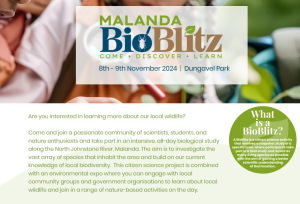
8th – 9th November 2024 | Dungavel Park
Are you interested in learning more about our local wildlife?
Come and join a passionate community of scientists, students, and nature enthusiasts and take part in an intensive, all-day biological study along the North Johnstone River, Malanda. The aim is to investigate the vast array of species that inhabit the area and build on our current knowledge of local biodiversity. This citizen science project is combined with an environmental expo where you can engage with local community groups and government organisations to learn about local wildlife and join in a range of nature-based activities on the day.
Malanda Bio-Blitz 2024 with Christine Doan
She recounts decades of efforts and setbacks in reforesting the Tablelands area while urging today’s generation to continue planting trees and participating in citizen science. Her key message is perseverance in environmental restoration and planting for the future.
Christine’s Video Transcript
Hi bio blitzers! I want to talk to all of you, whether you’re Gen Xers, Gen Ys, Gen Zeds – I don’t care if you’re Gen Alphas. I hope a lot of you are Gen Alphas out there. I’m addressing you not from this century, not from this millennium, but from the last century and the last millennium. I’m a baby boomer; look at the wrinkles! I have a message of hope and optimism for you though, as a baby boomer, and that is: never think you started too late. When you’re starting is when you start.
How many failures have we had in revegetating the North Johnstone and the area around it? How many failures? Lots. But how many successes? Even more. And any success is a success. The failures only teach you how to do it better. We started this back in the 1970s. I first bought the block across the river north of Malanda in the 70s, and guess what? The Forestry at that time was really interested in creating a forestry industry on the Tablelands. They sort of had the wrong ideas, the science wasn’t very good; it was a long time ago. But think of this: we started, we just got started. Heaps of scientific research was done on that very block. If there weren’t so many rainforest trees in the way where you’re standing now, that’s why I have a message of hope: start now, because we learned so much from what we did in the 70s.
What did we do in the 80s? More of the same. The Forestry slowly moved away from the idea of building an industry up here. Some of us private individuals took over. We didn’t quite succeed, but we were ahead of our time. You have to keep trying. What happened next? The Wet Tropics Management Authority came in with lots of money – so much money we couldn’t believe it. Could they give that money to farmers? Nope. Nobody wanted to revegetate their riparian zones, the edges of the rivers.
So, if you look at all the vegetation along Clevenson Creek, which today looks like an old, established rainforest, let me tell you: it was all planted easily within my lifetime, within my time on the Tablelands. Start planting now. Plant a tree tomorrow, and when you’re 50, you’ll be so grateful you planted the tree today or tomorrow. Plant ten trees tomorrow – even better! The message is: never give up. Bio-blitzing is never too late. Do it as soon as you can. If you’re doing it, good on you!
After the 80s, after the Wet Tropics Management Authority did what it could and ran out of puff, we started doing more. We applied for environmental grants and got funding for the environment. And guess who came along? The entire community. By that time, I wasn’t alone; there was a whole horde of people supporting me. JCU students showed up, the school for field studies came every year, and we had people in their hundreds for community plantings. Even for the smaller ones, we still had many volunteers.
We planted up to 10 hectares that got completely wiped out, except for one single tree, by Cyclone Larry. Did we give up? Nope. We just kept on planting. The result? Now, behind Dungavel Park, there is what we call a “wildlife corridor.” It’s not quite wide enough to be a true wildlife corridor, but we call it that – a tree kangaroo corridor. Now, tree kangaroos don’t have to cross open paddocks; they can move from tree to tree, jumping freely through the trees.
And who did all that planting? Everyone. Baby boomers, Gen Xers, and even their kids participated. You, bio blitzers today – whether you’re Gen X, Y, Z, or Alpha – you are the future of the environment. Don’t give up. Keep planting, keep revegetating, and keep discovering through citizen science. You are the future.
Leave a Reply